For gamers who have been anticipating the release of this game for over seven years (practically an eternity in game development), Gray Matter will inevitably polarize us into two groups:
- Those who will criticize it for not being perfect despite “all that extra time” the developers have had to work on it
- Those, like myself, who are simply so grateful to finally be able to play this gem that we are willing to look past its shortcomings.
The most glaring criticisms are the game’s graphics and animations. (Let’s get the bad stuff out of the way, shall we?) If you are expecting an adventure game with cutting edge graphics and animation, you will not find it here. What you can expect, however, is a game that is rich in story, mystery, and the supernatural. In other words, it’s all the things that fans of Jane Jensen’s games have come to expect. Gray Matter tells a beautifully crafted story with interwoven themes of science vs. magic, love and obsession, death and forgiveness. Set in Oxford, the game is steeped in history and atmosphere, and features real locations from around England rendered into beautiful, softly lit backdrops.

There are two main characters that the player controls alternatively in different chapters: Samantha (“Sam”) Everett, a young, spunky ex-goth street magician who has spent most of her well-traveled life in and out of foster care, and Dr. David Styles, a brilliant but reclusive neurobiologist with a tragic past. Both of their lives begin to change when Sam shows up at the doorstep of Dread Hill House one rainy night, desperate for a job and a place to stay. Still mourning his dead wife and consumed by his experiments, Dr. Styles soon becomes entangled in powerful forces he does not understand, and it’s up to Sam–who has an agenda of her own–to help him.
The story unfolds in a careful, suspenseful manner that gives us insight into both characters’ minds and emotions. Neither of them hold all the clues or know all the answers, and both of them are deeply flawed in one way or another. That’s all I will say without giving too much away.
The voice acting ranges from just okay to great, with Sam’s voice leaning toward the low end of the spectrum; a bit disappointing given her huge role. There are certainly moments when her voice shines, but overall I felt it didn’t quite fit her character and wasn’t always genuine. On the opposite end, David’s voice was excellent. The game’s score and soundtrack is another highlight. The few subtle musical tracks are wonderfully composed, if a bit repetitive. (I’m now a Scarlet Furies fan, by the way.)
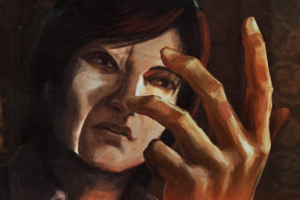
The game also features graphic novel-style cutscenes that have a hand-painted look and feel. I very much enjoyed the game’s art style, but critics will most likely ding the cutscenes for being a byproduct of low budget. I at least applaud the developers for doing something unique and creative given their limitations.
Most of the puzzles are logical inventory-based puzzles that fit the situation the protagonists find themselves in. You will not encounter any random, out of place puzzle mechanisms that seem to exist just to slow your progress, or be required to go on any tedious pixel-hunting tangents. The game’s magic trick system is innovative and provides some unique gameplay, but it’s also not much of a challenge.
Overall, the puzzles aren’t that difficult, but they are sometimes presented in a non-linear fashion that I often found confusing. For example, gold locations on your map indicate that there’s “something left to do” at that location. However, the game will not let you progress until you go to another location, work on a separate puzzle for a while, then come back later. You will find yourself checking the Chapter Progress screen frequently.
One issue I have with many adventure games is the copious amounts of reading. Though Gray Matter does have its fair share of in-game documents and other printed miscellany, it’s usually presented in such a way that’s easy to digest and actually somewhat informative and interesting. (You may even find yourself learning a thing or two about magic–who else tried some of Sam’s tricks out on their friends?) And of course, in classic Jane Jensen style, there’s plenty of humor, in-jokes, and pop culture references.
Gray Matter proves, as most great adventure games do, that graphics are not the only thing that makes a game good. If you can look past it’s rough edges, Gray Matter will reward you with satisfying gameplay, lovable characters, and a truly riveting story that comes to an exciting and satisfying conclusion. But perhaps the more amazing story is how Gray Matter survived through years of development hell and lived to tell its tale.
Yes, Gray Matter was absolutely worth the wait.