How many times have you gotten stuck in an adventure game because you missed one tiny little pixel you somehow neglected to click? Or because you couldn’t make sense of the convoluted story hinted at within the 300 pages of books and diaries the game expects you to read? Or maybe you didn’t realize that you were supposed to combine the rope with the rubber chicken (how silly of you) which turns out to be miraculously critical in making your great escape. It’s hair-pulling moments like these when the temptation to use a walkthrough is at its strongest. It’s the inevitable ethical dilemma all adventure gamers must face: do I continue to waste hours getting nowhere, or do I take one little peek at the answers? We’re torn between the desire to feel satisfied in solving puzzles for ourselves, and on the other hand, the desire to merely get on with the rest of our lives.
If you’re like me, you’ll reach one of these maddening impasses and at least try to give it your best shot. You’ll click and double-click everything, retrace your steps, talk to everyone, and exhaust a good hour or two of playtime before your brain transforms into Jello and your once optimistic powers of reasoning deteriorate into thoughts of obscene and utter contempt for the makers of such mindfucks, that were obviously designed specifically to destroy you. I’ve been there.
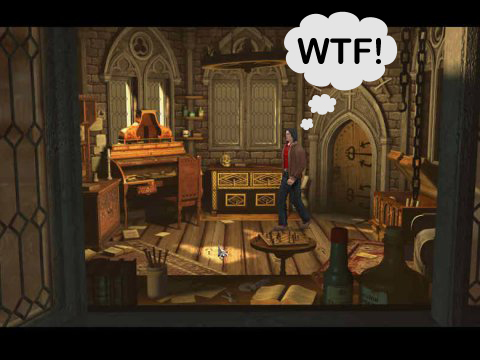
Case in point: Last night while playing The Black Mirror, I got stuck in William Gordon’s tower study room and for the life of me could not figure out why. I knew I was looking for a diary, and I knew it would be in this room. I picked up every object there was to pick up, tried combining items to no avail, and clicked and double-clicked on every square pixel of screen real estate that I could. Yet the game would not let me leave the room, stating that “I need to explore this area more thoroughly.” When I realized I had wasted over an hour in this single room, I decided to sacrifice my pride and guiltily consult a walkthrough, feeling stupid and defeated. And you know what it turns out I was doing wrong? I needed to right-click on the damn desk drawer to find the secret hidden diary, not left-click it. (WTF!) So even though I had already figured out exactly where to go and what to do, an unfortunate technicality prevented my progression.
When it comes to adventure games, I believe there’s a fine line between difficulty and poor game design.
Let’s be honest, game designers sometimes do things that are just plain stupid and/or make no sense. And it’s circumstances like the one described above when I will happily consult a walkthrough and not feel guilty afterward. When we learn puzzle solutions in a walkthrough, we will usually experience one of two reactions:
- Wow, how could I have missed that!??
- OMFG that is SOOOOO stupid!
The first reaction typically leads to feelings of guilt and shame for having looked up the answer. But if it’s the second reaction, should we feel justified? I say yes. Can it really be considered cheating if a game’s poor design or quirky control system practically requires you to cheat? (Of course, the only problem is, you won’t know the difference until you’ve cheated…)
So in the interest of restoring everyone’s dignity during our moments of desperation, I’d like to propose the following:
Using a walkthrough is not cheating when…
- You already know where to go and what to do, but cannot figure out exactly how to do it.
- You discover something important or connect the dots earlier than the game’s protagonist, and you must then do excessive amounts of backtracking to bring your less intelligent alter-ego up to speed.
- Terrible control or interface designs make otherwise easy tasks exceedingly difficult.
- The game has known bugs that inhibit progression.
- Excessive use of red herrings featured in the game.
- Puzzle solutions turns out to be almost completely illogical, with no prior clues given for how to go about solving them.
- Solution requires combining two completely unrelated objects in a nonsensical fashion to become keystone of epic McGuyver-like proportions.
I remember playing adventure games before the Internet. Before walkthroughs, before GameFAQs. Before you could just Google a description of the exact part of the game you were stuck on and be met with hundreds of detailed, pictorial solutions. Those were the days. You felt a real sense of accomplishment when you completed games. Nowadays it’s far too easy to Google up the answers, or worse, unintentionally stumble upon cheats and spoilers posted online. I guess one solution could be to avoid the Internet completely while you’re playing a game, but let’s be realistic here. These are the reasons why I’m thankful for sites like Universal Hint System which is helpful without giving too much away. After all, the very reason we play adventure games is because we enjoy games that reward us for our cleverness and intuition, not punish us with frustration and feelings of inferiority.